AI Prototype – Identity Access Risk Analyzer


The Problem I Kept Seeing
In most enterprises I’ve worked with, identity risk doesn’t fail loudly — it silently accumulates.
Users retain access long after they need it.Privileged roles remain active despite inactivity.And risk reviews happen periodically, not when risk actually emerges.
Traditional IAM systems try to solve this using:
Static rules
Periodic certifications
Manual reviews
But the reality is: Risk is dynamic — while controls are static
The Idea
I wanted to explore a simple question: Can AI help identify identity risk in real time, using contextual signals like access level and activity?
Instead of building a full system, I decided to prototype this quickly using:
Google Colab for rapid experimentation
Python (Pandas) for handling access data
OpenAI API for intelligent analysis
Secure key handling via Colab Secrets

Setting Up a Secure Prototype
One thing I was clear about — even in a prototype, security practices matter.
Instead of hardcoding API keys, I used Colab’s built-in secret manager.

Secure API Configuration
Store API key using Colab Secrets
Retrieve securely at runtime

Simulating Enterprise Access Data
To keep things simple, I created a small dataset representing:
Users
Roles
Last login activity
Privilege levels

Even with minimal data, the goal was to test: Can AI detect meaningful patterns?
Turning Rules into Intelligence
Instead of writing complex rule engines, I defined simple logic:
Admin + inactive → High risk
Elevated access → Medium risk
Normal users → Low risk
And passed this along with the data to the AI model.
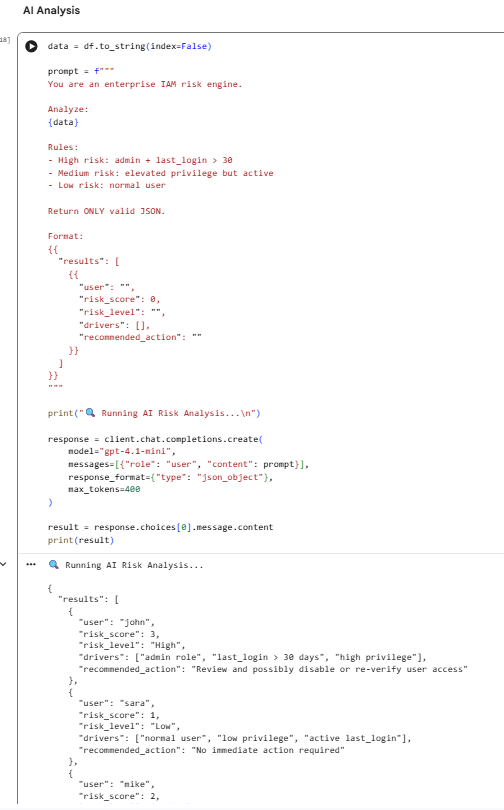
What I found interesting was not just classification — but reasoning.
The model could explain:
Why a user is risky
What signals contributed
What action should be taken
From Raw Output to Usable Insight
The response came back as structured JSON, which I converted into a table.

Now, instead of raw logs or access dumps, we get:
Risk scores
Risk levels
Drivers of risk
Recommended actions
What This Revealed
Even in this simple prototype, a few things became clear:
Identity risk is strongly tied to privilege + inactivity
AI can convert raw access data into actionable insight instantly
This approach removes dependency on manual audits
The Bigger Shift
This exercise reinforced something important: IAM is moving from static governance → continuous intelligence
Instead of asking:
“Who has access?”
We start asking:
“Who is risky right now?”
For enterprises, this means:
Reduced security exposure
Faster decision-making
Scalable identity governance
And more importantly: A shift toward risk-adaptive access models
What’s Next
This is just the starting point.
I’m extending this into:
Just-in-Time Access Decision Engine
Non-Human Identity Risk Classification
To explore how AI can evolve IAM into a real-time decision system


Comments