AI Prototype: Non-Human Identity (NHI) Risk Analyzer

The Problem Most Enterprises Miss
While user identities are heavily governed, non-human identities (NHIs)—such as service accounts and API keys—often remain overlooked.
n many environments, I’ve observed:
Service accounts running for years without review
API keys with high privileges and no clear ownership
Credentials that are rarely used—but never revoked
Unlike human identities, these do not trigger obvious alerts.
They don’t fail loudly—they quietly expand your attack surface.

The Idea
This led me to explore a key question: Can AI help detect risk in non-human identities using simple contextual signals?
Instead of relying on manual audits, I built a lightweight prototype that:
Identifies risky service accounts and API keys
Explains why they are risky
Recommends actionable remediation
How I Built It
To keep the prototype fast and practical, I used:
Streamlit → to build an interactive UI
GitHub → for version control and deployment
OpenAI API → for intelligent analysis and reasoning
Python (Pandas) → for data processing and risk scoring
Simulating Enterprise NHI Data
I created a simple dataset representing:
Service accounts
API keys
Last usage (in days)
Privilege level
Ownership
Even with minimal data, the goal was to test: Can meaningful risk patterns emerge from basic signals?
Turning Signals into Risk Intelligence
The system evaluates risk in two layers:
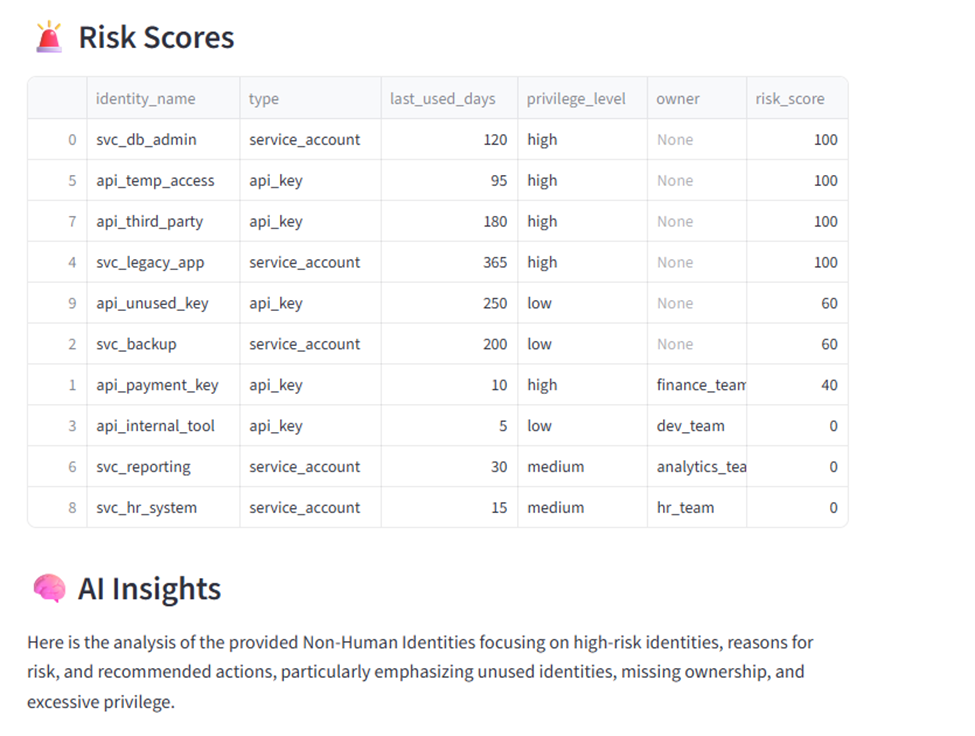
1. Deterministic Risk Scoring
Basic rules:
High privilege → increased risk
Inactivity (>90 days) → increased risk
Missing owner → critical risk
This produces a risk score per identity
2. AI-Powered Reasoning
The enriched data is sent to the OpenAI model, which:
Identifies high-risk identities
Explains contributing factors
Recommends actions such as:
Revoke unused accounts
Rotate API keys
Assign ownership
From Data to Insight
Using Streamlit, I built a simple interface:
Upload CSV with NHI data
View calculated risk scores
Generate AI insights instantly
This transforms raw identity data into: Actionable security intelligence
Testing the System
High Risk
Service account unused for 120+ days
High privilege + no owner
Recommendation: Revoke or disable immediately
Medium Risk
API key with high privilege but active usage
Recommendation: Apply monitoring and rotate periodically
Low Risk
Active identity with assigned owner
Recommendation: No action needed
Key Insights
This simple prototype revealed:
NHI risk is strongly driven by inactivity + privilege + ownership gaps
AI can quickly convert raw identity data into clear decisions
Many high-risk identities are invisible to traditional controls
The Bigger Shift in IAM
This exercise reinforced an important shift:
From:
Human-centric identity governance
Periodic reviews
To:
Holistic identity security (human + non-human)
Continuous risk evaluation
Why This Matters
For enterprises, improving NHI visibility means:
Reduced attack surface
Better control over service accounts and API keys
Improved compliance and audit readiness
Most importantly: Security moves from reactive cleanup → proactive detection
Final Thought
Non-human identities are growing faster than human users in modern systems.
If we don’t govern them, they will become the weakest link in security.
AI gives us a way to finally bring visibility and intelligence into this space.





Comments