AI Prototype: Just-in-Time Identity Access Decision Engine

The Problem I Kept Seeing
In most enterprises I’ve worked with, identity risk doesn’t fail loudly—it silently accumulates.
Users retain access long after they need it
Privileged roles remain active despite inactivity
Access reviews happen periodically, not when risk actually emerges
Traditional IAM systems try to solve this using:
Static rules
Periodic certifications
Manual reviews
But the reality is simple: Risk is dynamic — while controls are static
The Idea
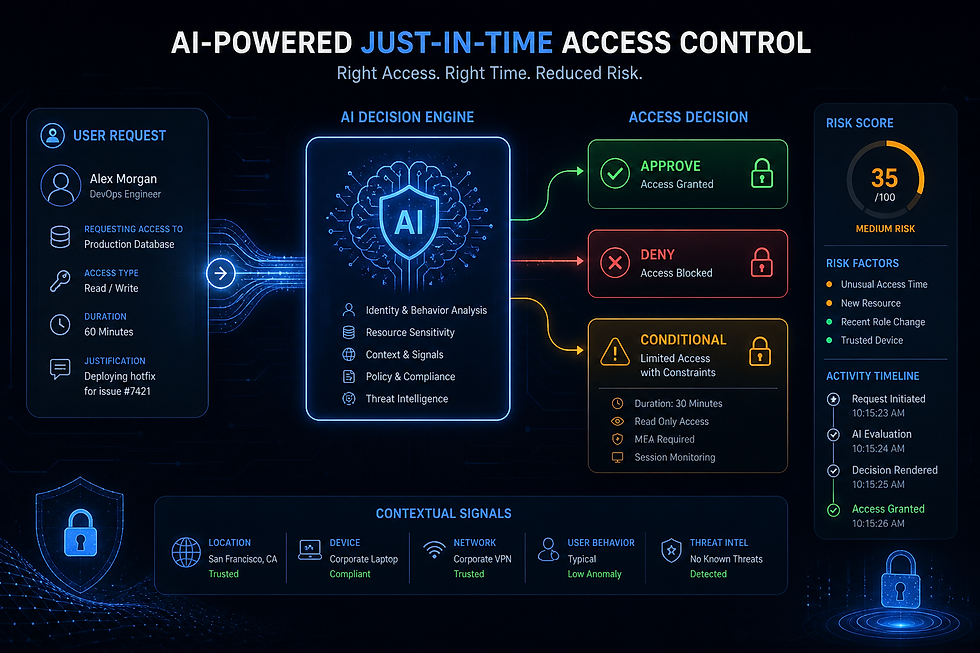
I wanted to explore a fundamental shift: Can access decisions be made in real time based on risk?
Instead of asking: “Who has access?”
We should be asking: “Should this access be granted right now?”
This led me to build a lightweight prototype of a: AI-Powered Just-in-Time (JIT) Access Decision Engine
How I Built It
To keep things fast and practical, I used:
Streamlit → for building a simple interactive UI
GitHub → for version control and deployment
OpenAI API → for intelligent decision-making
Python (Pandas) → for handling data and risk logic
Instead of analyzing CSVs offline, I simulated a live access request flow.
Input (User Request)
User name
Role
Last login activity
Privilege level
Requested access
Decision Engine
The system evaluates risk in two layers:
1. Deterministic Risk Scoring
Simple logic:
High privilege → higher risk
Admin role → higher risk
Inactivity (>90 days) → higher risk
This produces a risk score (0–100) instantly.
2. AI-Based Decisioning
The risk score + user context is sent to the OpenAI model, which decides:
APPROVE
APPROVE WITH CONDITIONS
DENY
Along with:
Reasoning
Risk drivers
Recommended controls
Building the Interface
Using Streamlit, I created a simple UI:
Input form for access request
“Evaluate Access” button
Real-time decision output
This transforms the prototype from: code → into a working product experience
Secure Deployment
The app was deployed using:
GitHub repository for code management
Streamlit Cloud for hosting
Sensitive data like API keys were handled securely using:
Environment variables / Secrets (not hardcoded)
Testing the System
I tested multiple real-world scenarios:
Scenario 1: High Risk
Admin + inactive (120 days)
Result: Deny access
Scenario 2: Medium Risk
User + high privilege + moderate activity
Result: Conditional approval
Require MFA
Time-bound access
Scenario 3: Low Risk
Active user + low privilege
Result: Approve access
Key Insights
Identity risk is strongly tied to privilege + inactivity
AI can convert raw signals into real-time decisions
Static reviews can be replaced with continuous evaluation
The Bigger Shift
This experiment reinforced a broader transformation in IAM:
From:
Static governance
Periodic reviews
To:
Real-time decisioning
Risk-adaptive access
Why This Matters
For enterprises, this approach enables:
Reduced security exposure
Faster access decisions
Scalable identity governance
Better auditability
Most importantly: Access becomes contextual, not permanent
What’s Next
This is just the starting point. I’m extending this into:
Just-in-Time Access Provisioning (time-bound access)
Non-Human Identity Risk Analysis
Continuous risk monitoring



Comments